
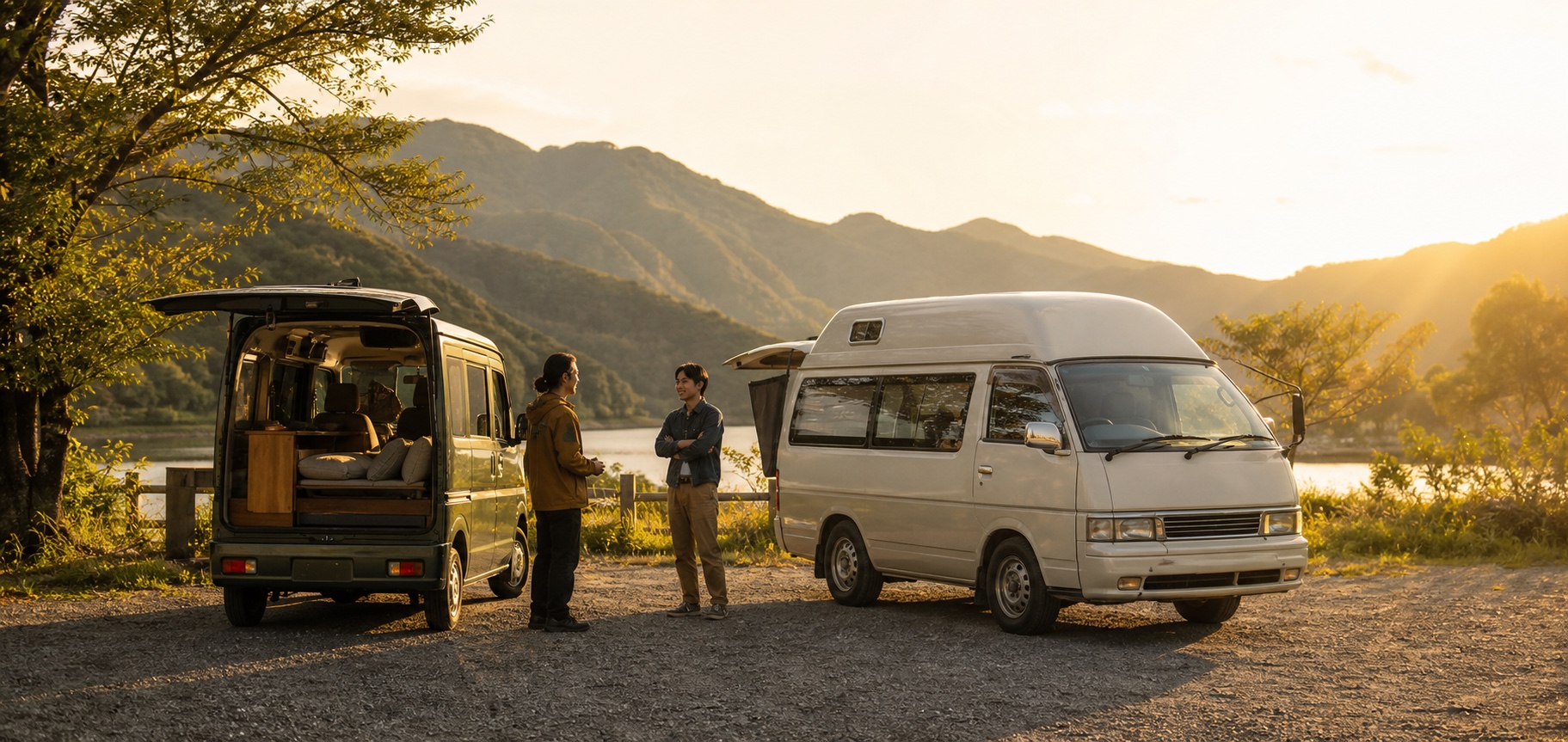
The campervan market in Japan is in a strange but interesting place.
More people own camping cars than ever before. You can feel that on the road, at RV parks, at shows, and in the number of small converters building clever layouts for kei vans, Hiace vans, and larger motorhomes.
But the latest industry data also shows a slowdown in new production and sales. So the story is not simply "Japan loves campervans and everything is growing." It is more useful than that.
According to the Japan Recreational Vehicle Association's 2025 annual report release, Japan reached 173,000 campervans in domestic ownership in 2025, the highest number recorded by the association. At the same time, end-user campervan sales fell to about 91.7 billion yen and domestic production fell to 7,727 vehicles.
That combination matters if you are planning to rent, buy, sell, or travel by van in Japan.
The three numbers to know
Here is the simple version.
| Metric | Latest figure | What it means |
|---|---|---|
| Campervans owned in Japan | 173,000 vehicles in 2025 | The total number on the road is still rising |
| Campervan sales value | About 91.7 billion yen in 2025 | Sales fell compared with the previous year |
| Domestic production | 7,727 vehicles in 2025 | Builders produced fewer vehicles for the second year in a row |
The important thing is that these numbers are moving in different directions.
Ownership is still going up. That means the culture is growing. But production and sales are down, which means the new-vehicle side of the market has been under pressure.
Why ownership can rise while sales fall
This sounds confusing at first, but it makes sense.
The total number of campervans in Japan is like a stock of vehicles. It can keep growing as long as more vans are added than removed from the road.
Sales and production are flows. They show what happened during the year. If new base vehicles are hard to get, converters cannot build as many camping cars, even if customers still want them.
JRVA says the main reason for the production decline was the shortage or delay of base vehicles from automakers. This matters a lot in Japan because many camping cars are built from normal commercial vehicles first. If the base Hiace, TownAce, kei van, or truck chassis is late, the finished camping car is late too.
This was not completely new in 2025. JRVA's 2024 annual report release also mentioned base vehicle supply problems, even though 2024 vehicle sales reached a record 112.65 billion yen and ownership reached 165,000 vehicles.
So 2025 looks less like a collapse in interest and more like a supply problem catching up with a market that had been growing quickly.
What this means if you want to rent a campervan
For travelers, the main lesson is simple: book early in busy seasons.
Japan has more campervans than before, but the rental fleet is not infinite. Good rental vans around Tokyo, Narita, Haneda, Osaka, Fukuoka, and Hokkaido can still disappear quickly for cherry blossom season, Golden Week, summer holidays, autumn leaves, and ski season.
If base vehicles are harder for builders to get, rental companies cannot always expand their fleets quickly. That means demand can rise faster than supply, especially for popular vehicle types:
- compact vans for couples
- larger family vehicles
- pet-friendly rentals
- winter-ready vans with heaters
- one-way rentals or regional pickup
If your travel dates are fixed, compare companies early on the Camp in Japan rental search. If your dates are flexible, you will usually have more options by avoiding national holidays and peak weekends.
What this means if you want to buy
For buyers, the market has two sides.
New builds can be expensive, slow, or hard to secure if the converter is waiting for base vehicles. Some buyers may need to wait months, compromise on layout, or choose from available stock instead of ordering the exact build they imagined.
At the same time, the used market becomes more important. More people own campervans now, which means more vehicles will eventually come back onto the market. But good used vans can move quickly, especially if they have valid shaken, a clean maintenance history, winter tires, solar, a heater, or a practical layout for Japan.
If you are shopping second-hand, look carefully at the boring details:
- shaken date
- mileage
- rust
- leaks
- battery age
- tire age
- air conditioning
- heater safety
- registration type
- maintenance records
You can start with our guide to buying a camper in Japan, or browse the second-hand van marketplace to see what is already listed by the community.
What this means if you already own a van
If you already own a good van in Japan, this market can work in your favor.
Rising ownership shows that demand is real. Supply limits can also make clean used vehicles more attractive. If your van is well maintained, legal, photographed clearly, and easy for a buyer to understand, it may be easier to sell than people expect.
The key is to be transparent. List the problems too. A buyer who understands old vans will not be scared by normal age-related issues, but surprise repairs after the first message usually waste time for everyone.
If you are preparing a listing, read our article about the second-hand van marketplace for Japan.
Why this is bigger than vehicle sales
The campervan market is not only about buying vehicles.
JRVA's 2025 report also says about 80 percent of owners use their camping car for travel, and about 70 percent take trips of two nights or more. The most common spending band during campervan trips was 30,000 to 60,000 yen.
That is important for rural Japan.
When people travel by van, the money does not only go to hotels. It spreads into roadside stations, supermarkets, local restaurants, onsen, ferries, fuel stations, campgrounds, RV parks, laundromats, repair shops, and small attractions that are hard to reach by train.
This is one reason we are seeing more interest in RV parks and drive tourism. The vehicle is only one part of the system. The overnight network, rental companies, local tourism, road services, and trip-planning tools all matter too.
What to watch next
The next few years will probably depend on three things.
First, whether base vehicle supply becomes easier for builders. If converters can get the vehicles they need, production can recover.
Second, whether the used market becomes more organized. Japan still has many scattered listings, dealer pages, auction routes, and private sales. Better discovery would help both buyers and sellers.
Third, whether the overnight infrastructure keeps improving. More official RV parks, better booking systems, and clearer rules at places like michi no eki would make van travel easier for beginners and foreign visitors.
Japan is not suddenly becoming North America or Australia. Roads are narrower, parking is tighter, rules matter, and overnight spots need to be handled carefully.
But the direction is clear enough: campervans are no longer a tiny niche here. The market is maturing, and that is good news for travelers if the infrastructure keeps up.