
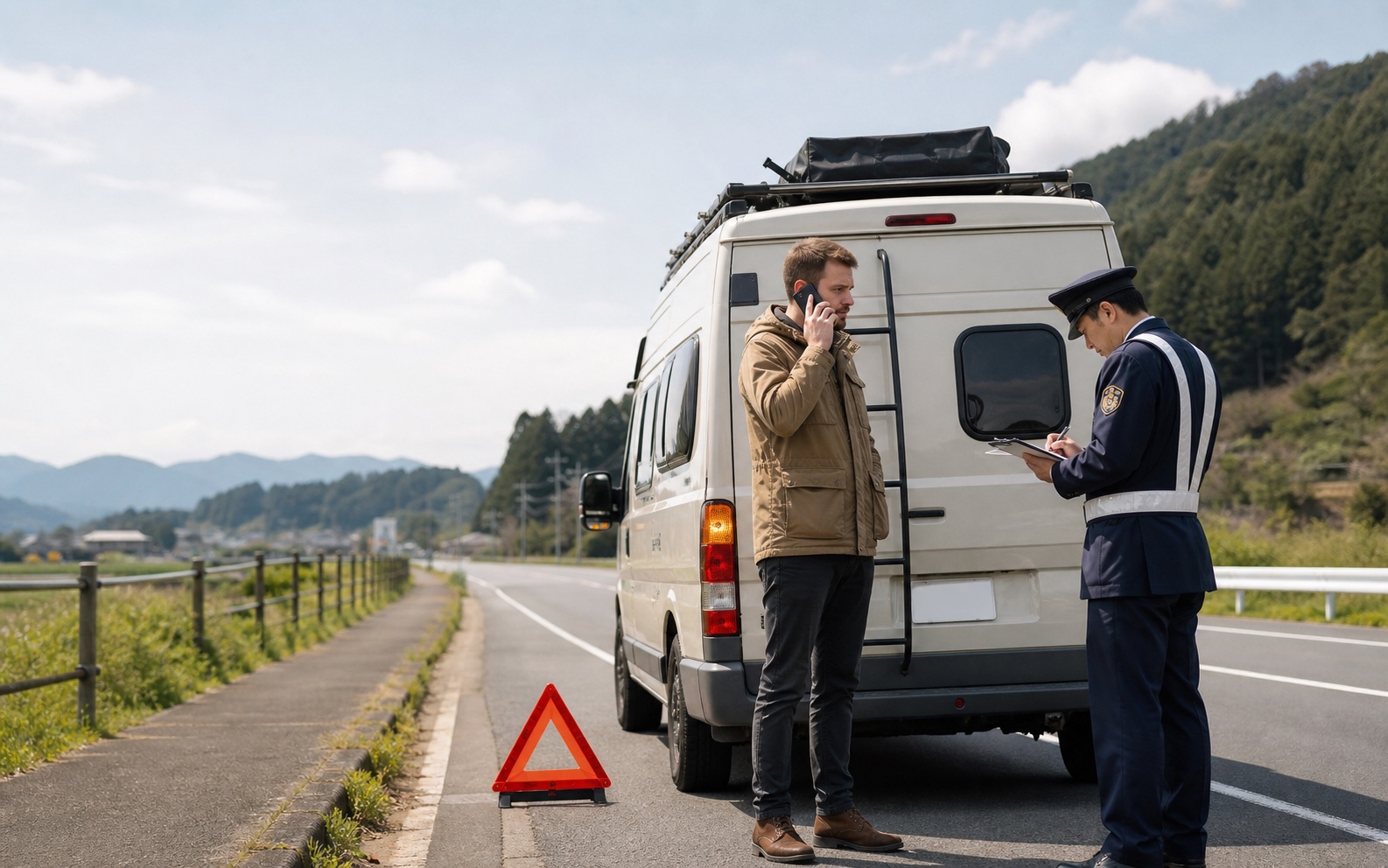
A car accident in Japan can be confusing even if the damage looks small. You may be dealing with Japanese police, a rental company, another driver, insurance paperwork, and a language barrier all at once.
The important thing is to slow the situation down. Make the scene safe, call the right emergency number, report the accident, and document what happened.
This guide is written for foreign drivers, campervan renters, and van travelers in Japan. It is practical road-trip advice, not legal advice.
For general road rules before you drive, start with our driving in Japan guide.
Emergency numbers in Japan
Remember these two numbers:
- 119 - ambulance and fire
- 110 - police
If anyone is injured, call 119 first. If there is a traffic accident, call 110 and report it to the police.
The Japan National Tourism Organization emergency guide lists emergency contact information for travelers, and the National Police Agency Traffic Bureau provides English traffic safety information, including its guide on what to do in the event of a traffic accident.
Step 1: Stop safely
Stop the vehicle. Turn on your hazard lights. If you can move out of traffic safely, do so, but do not create a second accident trying to reposition the vehicle.
On expressways, mountain roads, tunnels, bridges, and blind corners, the biggest danger after a crash is often the next vehicle coming toward you.
If it is safe:
- turn off the engine
- put on reflective gear if you have it
- set up a warning triangle if available
- move people away from traffic
- do not stand behind or between vehicles
If the vehicle is in a dangerous location and cannot move, call for help immediately.
Step 2: Call 119 if anyone is injured
Call 119 if anyone is hurt, trapped, dizzy, bleeding, unconscious, in shock, or unsure whether they are okay.
Use simple English if needed. Many emergency dispatch centers can arrange interpretation support, but the first few seconds are about communicating the basics: location, accident, injury, and number of people.
Useful phrase:
交通事故です。けが人がいます。救急車をお願いします。
Koutsuu jiko desu. Keganin ga imasu. Kyuukyuusha o onegai shimasu.
It is a traffic accident. Someone is injured. Please send an ambulance.
Step 3: Call 110 and report the accident
Call 110 for the police. Do this even if the accident seems minor.
This is the part visitors are sometimes tempted to skip, especially if both drivers look calm and the damage is only a scratch. Do not skip it. Police reporting is important for the official record, rental company procedures, and insurance handling.
The Japan Automobile Federation emergency measures guide also explains that traffic accidents should be reported to the police.
Useful phrase:
交通事故を起こしました。警察をお願いします。
Koutsuu jiko o okoshimashita. Keisatsu o onegai shimasu.
I had a traffic accident. Please send the police.
Step 4: Contact the rental company or insurer
If you are in a rental campervan, contact the rental company as soon as the scene is safe and emergency calls have been made.
They may tell you:
- whether the vehicle can be driven
- where to tow it
- how to handle insurance
- whether a replacement vehicle is possible
- what photos or documents they need
- whether you must wait for police before moving
If the next step involves a workshop visit, our Japanese mechanic phrases guide can help with estimates, repair vocabulary, and explaining the problem.
If you own the vehicle, contact your insurance company. If you are using a membership service or roadside assistance, ask whether towing is covered.
Do not promise private payment, accept blame, or agree to settle everything on the spot. Keep the conversation factual and let the police, rental company, and insurer handle the process.
Step 5: Exchange and record details
When it is safe, record the other driver's information. You may need:
- name
- phone number
- address if they provide it
- license plate number
- vehicle make, model, and color
- insurance company details
- photos of damage
- location and time
- witness contact details
If there is a language barrier, use a translation app and keep messages simple.
Useful phrase:
保険のために、連絡先を交換してもいいですか?
Hoken no tame ni, renrakusaki o koukan shite mo ii desu ka?
For insurance, may we exchange contact details?
Step 6: Take photos only when safe
Photos are useful, but safety comes first. Do not stand in the road to get a better angle.
If safe, photograph:
- all vehicles from several angles
- close-ups of damage
- license plates
- road signs and signals
- lane markings
- skid marks or debris
- the wider scene
- your dashboard or warning lights
If you have a dashcam, save the footage as soon as possible. Some systems overwrite old footage automatically.
Step 7: Ask about the accident certificate
For insurance and official procedures, you may need a Traffic Accident Certificate, called 交通事故証明書, koutsuu jiko shoumeisho.
The police report is part of the process, but the certificate itself is typically issued through Japan's traffic accident record system. The Ministry of Land, Infrastructure, Transport and Tourism accident guidance explains post-accident response and compensation-related procedures in English.
If you are renting, ask the rental company what they need. They may handle this with their insurer, or they may ask you for specific police station details.
Useful phrase:
交通事故証明書は必要ですか?
Koutsuu jiko shoumeisho wa hitsuyou desu ka?
Is a Traffic Accident Certificate necessary?
Step 8: Get checked if you were hit
Even a low-speed crash can cause neck, back, or head symptoms later. If you feel pain, dizziness, nausea, numbness, headache, or unusual stiffness, seek medical attention.
This matters for your health first. It may also matter for documentation if symptoms appear after the accident.
Do not continue a long drive just to keep the itinerary moving. A campervan trip can be adjusted. A medical issue should not be ignored.
Useful emergency phrases
| Japanese | Romaji | English |
|---|---|---|
| 事故です。 | Jiko desu. | There has been an accident. |
| 交通事故です。 | Koutsuu jiko desu. | It is a traffic accident. |
| 救急車をお願いします。 | Kyuukyuusha o onegai shimasu. | Please send an ambulance. |
| 警察をお願いします。 | Keisatsu o onegai shimasu. | Please send the police. |
| けが人がいます。 | Keganin ga imasu. | Someone is injured. |
| 場所はここです。 | Basho wa koko desu. | The location is here. |
| 日本語があまり話せません。 | Nihongo ga amari hanasemasen. | I do not speak much Japanese. |
| 英語を話せる人はいますか? | Eigo o hanaseru hito wa imasu ka? | Is there someone who speaks English? |
Accident vocabulary
| Japanese | Romaji | Meaning |
|---|---|---|
| 事故 | jiko | accident |
| 交通事故 | koutsuu jiko | traffic accident |
| 警察 | keisatsu | police |
| 救急車 | kyuukyuusha | ambulance |
| けが人 | keganin | injured person |
| 保険会社 | hoken gaisha | insurance company |
| レンタカー会社 | rentakaa gaisha | rental car company |
| 交通事故証明書 | koutsuu jiko shoumeisho | Traffic Accident Certificate |
| 目撃者 | mokugekisha | witness |
| ナンバープレート | nanbaa pureeto | license plate |
| 連絡先 | renrakusaki | contact details |
| ドライブレコーダー | doraibu rekoodaa | dashcam |
A simple checklist for your phone
If you want the shortest possible version, save this:
- Stop safely and turn on hazards.
- Call 119 if anyone is injured.
- Call 110 and report the accident to police.
- Contact the rental company or insurer.
- Exchange details with the other driver.
- Photograph the scene only if safe.
- Save dashcam footage.
- Ask about the Traffic Accident Certificate.
- Get medical attention if you were hit or feel unwell.
Accidents are stressful, but the sequence is simple: safety first, emergency services second, documentation third. Once those pieces are handled, your rental company or insurer can guide the next steps.