
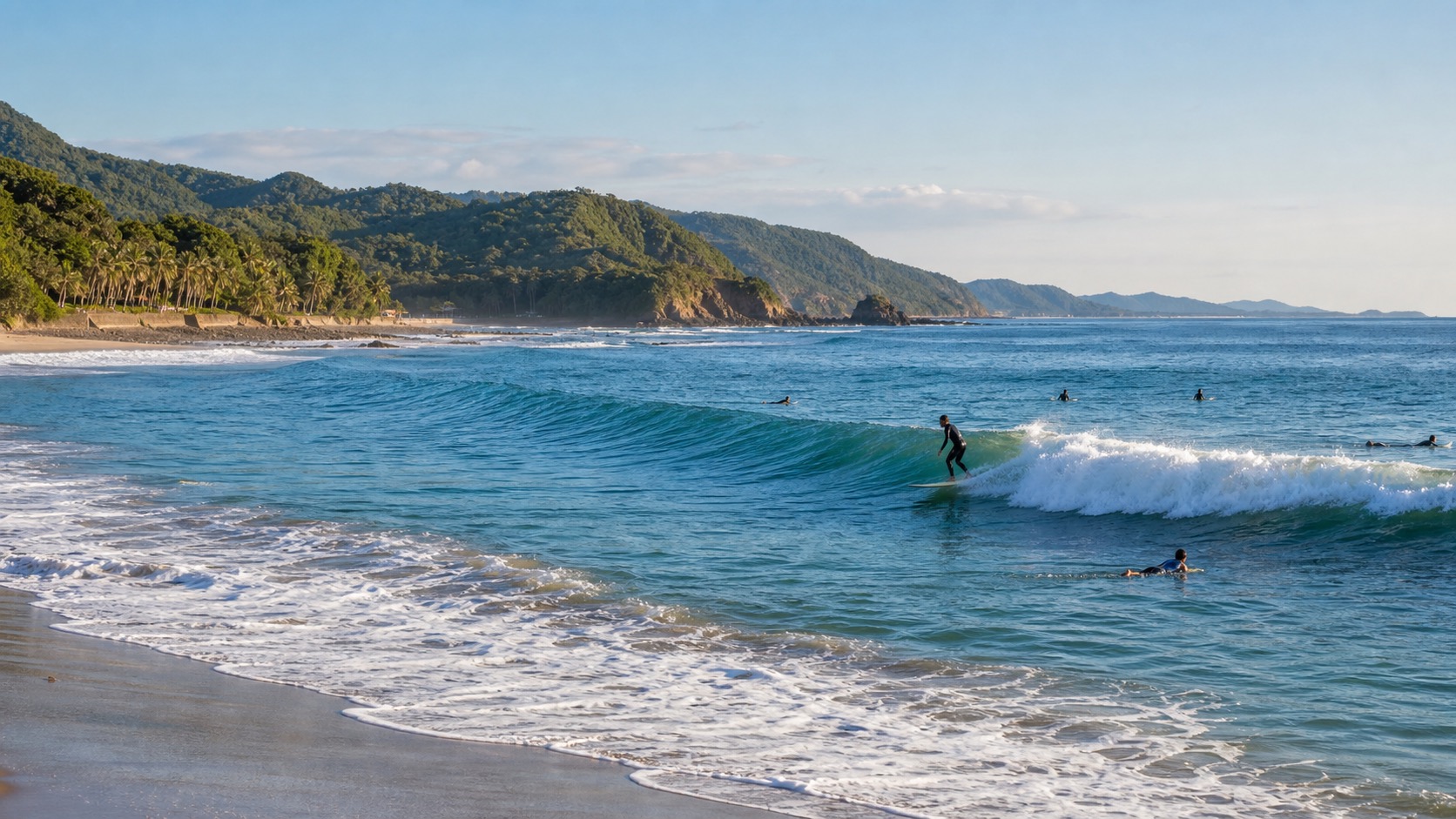
Miyazaki is one of the easiest places in Japan to build a surf road trip.
The prefecture has a long Pacific coastline, warm southern weather, regular swell, and several beaches where the surf infrastructure is already part of daily life. It is also very practical by van: you can check different beaches in the same day, dry gear between sessions, and link the coast with onsen, roadside stations, campgrounds, and the rest of Kyushu.
This is not a ranking of the most secret waves. It is a practical guide to the best-known and most useful surf spots in Miyazaki, especially if you are traveling by camper van or rental car.
For a wider overview, the official Miyazaki tourism site has a very useful Miyazaki surfing feature that divides the coast into central Miyazaki, Koyu, Hyuga/Nobeoka, and Nichinan/Kushima areas.
Quick advice before choosing a spot
If you are new to surfing in Miyazaki, start with Aoshima, Okuragahama, Ikurahama, or Kaguchihama. These are easier to understand, usually have better facilities, and are more forgiving places to organize a session.
If you already surf and want stronger beach-break energy, look at Kisakihama, Kanegahama, and Okuragahama.
If you are experienced and heading south, research Kazetahama, Umegahama, and Koigaura carefully before paddling out. The Nichinan and Kushima coast is beautiful, but some spots are more exposed, more powerful, or have limited facilities.
Always check the forecast, local rules, parking signs, and the lineup before entering the water. Miyazaki is welcoming, but these are local surf communities first.
Best season for surfing in Miyazaki
You can surf in Miyazaki all year, but the best season depends on what kind of trip you want.
Spring, from March to May, is a good balance for a road trip. The weather becomes easier, the beaches are less crowded than summer, and the surf can be fun without the full heat and humidity of July and August. You will usually want a wetsuit, especially early in the season.
Summer, from June to August, is warm, tropical, and easy for beach life. This is when Miyazaki feels most like a southern surf destination, but it is also busier, hotter, and more affected by typhoon swell. Summer can have small, friendly days and also serious storm-influenced days, so do not judge the ocean only by the weather on the beach.
Autumn, from September to November, is often the most interesting surf season. Water can stay comfortable, summer crowds start to fade, and typhoon-season swell can create very good waves. It is also the season where safety judgment matters most. If a typhoon is nearby, conditions can become dangerous even if the sky looks clear.
Winter, from December to February, is quieter and still surfable, especially compared with colder parts of Japan. You will need more rubber, mornings can be chilly, and some beach facilities may be limited, but it can be a good season for experienced surfers who want fewer crowds.
For most van travelers, April to June and September to November are the easiest windows. You avoid the peak summer crowds, the weather is still good for camping and driving, and the coast is more comfortable than in midwinter.
Do you need a wetsuit?
Usually, yes. Miyazaki is warm by Japanese standards, but it is not tropical all year.
As a rough guide:
- Winter: a full wetsuit is normally needed. Many surfers will want a warmer full suit, especially for early mornings.
- Spring: a full suit is still useful, then a lighter full suit or spring suit can work as the water warms.
- Summer: boardshorts or swimwear can be enough on warm days, but a rash guard or thin wetsuit top is still useful for sun, wax rash, wind, and jellyfish protection.
- Autumn: early autumn can still feel like summer, but a spring suit or full suit becomes useful as the season moves on.
If you are renting equipment or taking a lesson, ask the surf shop what they recommend that week. Local shops will know the water temperature, wind, and jellyfish situation better than any general guide.
Safety tips: typhoons, tsunami, jellyfish, and currents
Typhoons
Typhoon season is the main safety issue for a Miyazaki surf trip. Typhoons can bring excellent swell, but they also bring strong current, heavy rain, wind, storm surge, road closures, and dangerous beach conditions.
Before paddling out, check the Japan Meteorological Agency and local forecasts. If warnings, evacuation information, or dangerous marine conditions are in effect, do not surf. A beach can look tempting from the parking lot and still be unsafe because of current, closeouts, debris, or rapidly changing swell.
For van travelers, typhoons also affect the land side of the trip. Avoid sleeping next to the ocean, rivers, cliffs, or low-lying parking areas when a storm is approaching. Move inland, use proper accommodation if needed, and do not drive coastal roads during peak wind or heavy rain.
Tsunami
Miyazaki faces the Pacific, so tsunami awareness is essential.
If you feel strong shaking, or weaker shaking that lasts a long time, get out of the water immediately and move to high ground. Do not wait to see what other surfers do. Do not go back to the beach to collect boards, towels, cameras, or van gear.
Japan uses official tsunami warnings and advisories from the Japan Meteorological Agency. Beaches may also use red-and-white checkered tsunami flags. If you see one, evacuate immediately.
When you arrive at a beach, take 30 seconds to notice the evacuation route signs and the nearest high ground. This is especially important if you plan to surf at remote beaches in southern Miyazaki.
Jellyfish and marine life
Jellyfish risk changes by beach, weather, current, and season. In many parts of Japan, stings become more common in the warmer months and late summer, but you should treat it as a local, day-by-day issue rather than a fixed calendar rule.
Ask a surf shop or lifeguard if jellyfish are around. Wearing a rash guard, leggings, or a thin wetsuit layer can reduce exposure. If you are stung, leave the water, avoid rubbing the area, and seek local medical help if pain is strong, symptoms spread, or you are unsure what stung you. The Japan Coast Guard's water safety guide also advises leaving the water and getting medical attention after injuries from dangerous marine creatures.
Also watch for rays, sea urchins, sharp rocks, and reef depending on the spot. The southern coast around Nichinan and Kushima can feel more rugged than the easier sandy beaches around Aoshima and Hyuga.
Rip currents and local conditions
Long sandy beaches like Kisakihama, Okuragahama, Ikurahama, and Kaguchihama can have shifting banks and rip currents. Before entering, watch the ocean for a few sets. Look for where surfers are paddling out, where water is moving back to sea, and whether the waves are closing out across the whole beach.
If you are caught in a rip, do not fight straight back to shore. Stay calm, float or paddle sideways out of the current, then come in with the waves. If you are tired, signal for help.
The simplest safety rule in Miyazaki is this: if you are unsure, ask a local surf shop, take a lesson, or choose an easier beach. There is no need to turn a road trip into a rescue situation.
Kisakihama
Open in Google Maps | Official tourism page
Kisakihama is the headline surf spot around Miyazaki City. It became internationally known when the ISA World Surfing Games were held here in 2019, and it remains one of the most important contest beaches in Japan.
The beach is long, open, and exposed, so it can pick up swell through much of the year. That is the appeal, but also the thing to respect. When the conditions are clean, Kisakihama can be excellent. When the wind is wrong or the swell is too strong, it can quickly become hard work.
For van travelers, Kisakihama is convenient because it is close to Miyazaki Airport, Miyazaki City, and Aoshima. The official spot page lists toilets, changing rooms, paid hot showers, free cold showers, and parking space, which makes it much easier than a remote beach if you have wet gear.
Best for: intermediate surfers, stronger beach-break days, contest atmosphere, airport-friendly surf trips.
Van note: this is a day-use surf spot, not a place to assume you can sleep in the parking area. Use proper overnight options around Aoshima, Miyazaki City, campgrounds, or official RV-friendly stops.
Aoshima Surf Point
Open in Google Maps | Official surf point page | Aoshima Beach page
Aoshima is the best first stop if you want a softer landing in Miyazaki. It has surf, beach facilities, cafes, hotels, restaurants, Aoshima Shrine nearby, and a more relaxed holiday feeling than the exposed contest beaches.
The southern side near the swimming beach is generally smaller and more beginner-friendly, while the waves tend to get bigger as you move north toward Kisakihama. It can also be a useful backup when Kisakihama is too heavy.
This is also one of the easiest places in Miyazaki to organize lessons, rentals, SUP, or a mixed day where some people surf and others just enjoy the beach area. If you are traveling with a family, a non-surfing partner, or friends with different levels, Aoshima is probably the most comfortable base.
Best for: beginners, lessons, families, mixed surf and sightseeing days, first Miyazaki session.
Van note: parking around Aoshima can be busy and some lots have time limits. Check signs carefully, especially if you arrive late or plan to stay into the evening.
Okuragahama
Open in Google Maps | Official tourism page | Official surf point page
Okuragahama in Hyuga is one of Miyazaki's classic surf beaches. It has a long sandy coast, regular surf, and a strong local surf identity. Hyuga City promotes the area as a surf town, and the beach has hosted major domestic and international competitions.
This is one of the best places in Miyazaki if you want to settle into a surf rhythm for more than one session. The beach is wide enough that you can often move along the coast to find a peak that suits your level, and the facilities are unusually good for a surf beach.
The official listings mention beach-house facilities, toilets, lockers, showers including hot showers, and nearby parking. For a van trip, that makes a big difference. Being able to rinse, change, and manage wet gear properly keeps the whole vehicle more comfortable.
Best for: a Hyuga surf base, all-level surf days, long beach walks, facilities, multi-day surf trips.
Van note: Hyuga is a good overnight area, but separate your surf parking from your sleeping plan. Look for campgrounds, RV parks, hotels, or legal overnight rest spots rather than defaulting to the beach lot.
Kanegahama
Open in Google Maps | Official tourism page
Kanegahama is another key Hyuga spot, just south of central Hyuga and close to Route 10. It has a more direct roadside feel than Okuragahama and is known for powerful waves.
The official tourism page describes it as a spot that attracts surfers and bodyboarders from across Kyushu and beyond. It is also practical: there are toilets, changing rooms, paid showers, a foot-wash area, food nearby, a convenience store nearby, and the Stairs of the Sea complex close to the coast.
This is a good spot to check when you are already in Hyuga and want a more powerful session, but it is not the most relaxed beginner option. If you are still learning, watch for a while and ask a local surf shop where to paddle out.
Best for: intermediate surfers, bodyboarders, powerful beach-break conditions, quick access from Route 10.
Van note: the official page lists no dedicated parking at the spot, so be careful not to block local roads, businesses, or residents. Arrive early and use proper parking.
Isegahama
Open in Google Maps | Official tourism page
Isegahama is a smaller and more scenic Hyuga option, framed by small capes on both sides. It is not the biggest-name surf spot in the prefecture, but it is a very useful place to know because the setting is beautiful and the facilities are solid.
The beach is around 300 meters long, with toilets, changing rooms, lockers, showers, rest space, and parking listed by the official tourism page. It is also recognized for clean water, which makes it a pleasant stop even when the surf is not the main event.
Because the beach is smaller than Okuragahama or Kisakihama, the lineup can feel more concentrated. Give people space and avoid paddling straight into the main peak if it is crowded.
Best for: scenic Hyuga sessions, smaller beach days, clean water, a slower stop between bigger surf beaches.
Van note: this can work well as a daytime stop before continuing to Cape Hyuga, Mimitsu, or a booked overnight place.
Ikurahama
Open in Google Maps | Official tourism page
Ikurahama, in Kawaminami, is one of the best middle-coast options if you want something mellower than the famous city and Hyuga spots.
The official tourism page describes it as a popular mellow surf point on a long coast of around 9 kilometers, with different wave sizes across the broader area. It also lists toilets, changing rooms, return-style coin lockers, free cold showers, and free parking.
That combination makes Ikurahama a very good van-travel stop: less intense than the famous contest beaches, but still easy enough to manage logistically. It is especially useful if you are driving between Miyazaki City and Hyuga and want to break up the coast.
Best for: mellow sessions, road-trip stops, all-level checks, avoiding the most famous beaches.
Van note: even when a spot feels quiet, do not spread gear across parking spaces or rinse wetsuits where water runs into pedestrian areas.
Kaguchihama
Open in Google Maps | Official tourism page
Kaguchihama, in Takanabe, is another practical middle-coast surf stop. The waves are generally described as gentle enough for beginners to enjoy, and the beach area has a campground nearby, which immediately makes it interesting for van travelers.
Facilities are a major advantage here. The official page lists toilets, changing rooms, free hot showers, and free parking. The beach opens as a swimming beach in summer, and the broader Takanabe area is also known for seasonal oysters in winter.
This is a good place to consider if your trip is not only about chasing the biggest waves. It gives you a surf check, a beach stop, and a more relaxed overnight or camping possibility nearby.
Best for: beginners, gentle sessions, camping-friendly planning, road trips between Miyazaki City and Hyuga.
Van note: if you want to camp, use the campground or another official option. Do not treat a beach parking lot as a campsite.
Kazetahama
Open in Google Maps | Official tourism page
Kazetahama, also listed as Shojuen, is one of the representative surf spots around Nichinan. It sits on the southern coast, where the coastline starts to feel more tropical and more exposed.
This is a beautiful area, but it is not as easy as Aoshima or Okuragahama. The official page notes powerful, consistent swell, limited parking space, and no toilets or showers at the spot. It is also known as a loggerhead turtle nesting area, so the environmental side matters.
If you are experienced, Kazetahama can be a strong south-coast option. If you are a beginner, get advice from a local surf shop first and consider easier beaches instead.
Best for: experienced surfers, southern Miyazaki road trips, powerful conditions.
Van note: limited parking means your behavior matters. Do not block access roads, do not leave trash, and avoid changing or cooking in ways that disturb local residents.
Umegahama
Open in Google Maps | Official tourism page
Umegahama, also associated with Lion Rock, is another Nichinan surf point with strong scenery. The coastline has clear water, sand, unusual rock formations, and a more rugged atmosphere than the easier central beaches.
The official page describes the waves as varied and notes that summer can be relatively big, making it more suitable for advanced surfers. Facilities are limited: there is a public toilet near Gion Shrine, but no showers at the spot.
Come here with a plan rather than as a casual first surf. Check the conditions, know where you can park, and avoid entering if you are unsure about the wave, rocks, current, or crowd.
Best for: experienced surfers, scenic checks, southern coastal drives, days when you have already researched conditions.
Van note: bring water for rinsing feet and gear, but keep runoff controlled. This is not a full-service surf beach.
Koigaura
Open in Google Maps | Official tourism page
Koigaura is one of the most beautiful surf settings in southern Miyazaki. It is in Kushima, near the far southern end of the prefecture, surrounded by blue water, green hills, and a very different feeling from Miyazaki City or Hyuga.
The official page describes it as a year-round surf point with many good-wave days and clear water. Facilities are limited but useful: toilets, free cold showers, and a very small free parking area are listed.
This is a rewarding destination if you are already building a southern Miyazaki route toward Cape Toi, Nichinan, or Kagoshima. It is not the fastest or simplest choice for a short trip, but it is one of the spots that makes Miyazaki feel special.
Best for: scenic surf trips, experienced travelers, southern Miyazaki routes, combining surf with Cape Toi.
Van note: parking is very limited, so have a backup. Our South Miyazaki recommendations include nearby road-trip ideas around Koigaura and Cape Toi.
How to build a Miyazaki surf route
For a first Miyazaki surf trip, keep the route simple:
Miyazaki City or airport pickup -> Aoshima -> Kisakihama -> Ikurahama or Kaguchihama -> Hyuga -> Okuragahama and Kanegahama
This gives you easy access, several wave options, proper facilities, and enough towns nearby for food, laundry, baths, and supplies.
For a longer southern route:
Aoshima -> Nichinan coast -> Kazetahama or Umegahama -> Koigaura -> Cape Toi -> Kagoshima or back toward Miyazaki
This route is more scenic and more remote. It is better if you already know how to read conditions and you are comfortable changing plans when the surf or parking situation is not right.
Vanlife tips for surfing in Miyazaki
Bring a plastic tub for wetsuits, a separate towel for the floor, a simple water container, and a place to hang wet gear. Salt water inside a van gets unpleasant quickly.
Do not assume that every beach parking lot allows overnight stays. Some close, some are used heavily by local surfers, and some are too exposed to wind or traffic. Use campgrounds, RV parks, hotels, or legal rest areas when you need to sleep.
Check shower information before you rely on it. Some showers are paid, some are cold only, some are seasonal, and some facilities close earlier than expected.
If the lineup is crowded, wait and watch. Miyazaki has many good surfers and strong local communities. The easiest way to have a good session is to choose the right peak for your level and avoid forcing yourself into the busiest takeoff zone.
Final advice
Miyazaki is not only good because it has famous surf spots. It is good because the whole coastline works as a road trip.
You can surf in the morning, drive to an onsen in the afternoon, eat local chicken nanban or seafood at night, and wake up close enough to check another beach the next day. That flexibility is exactly why Miyazaki is such a strong destination for surfers traveling by van.
Start with the practical spots, respect the local beaches, and leave room in the itinerary to move with the conditions.