
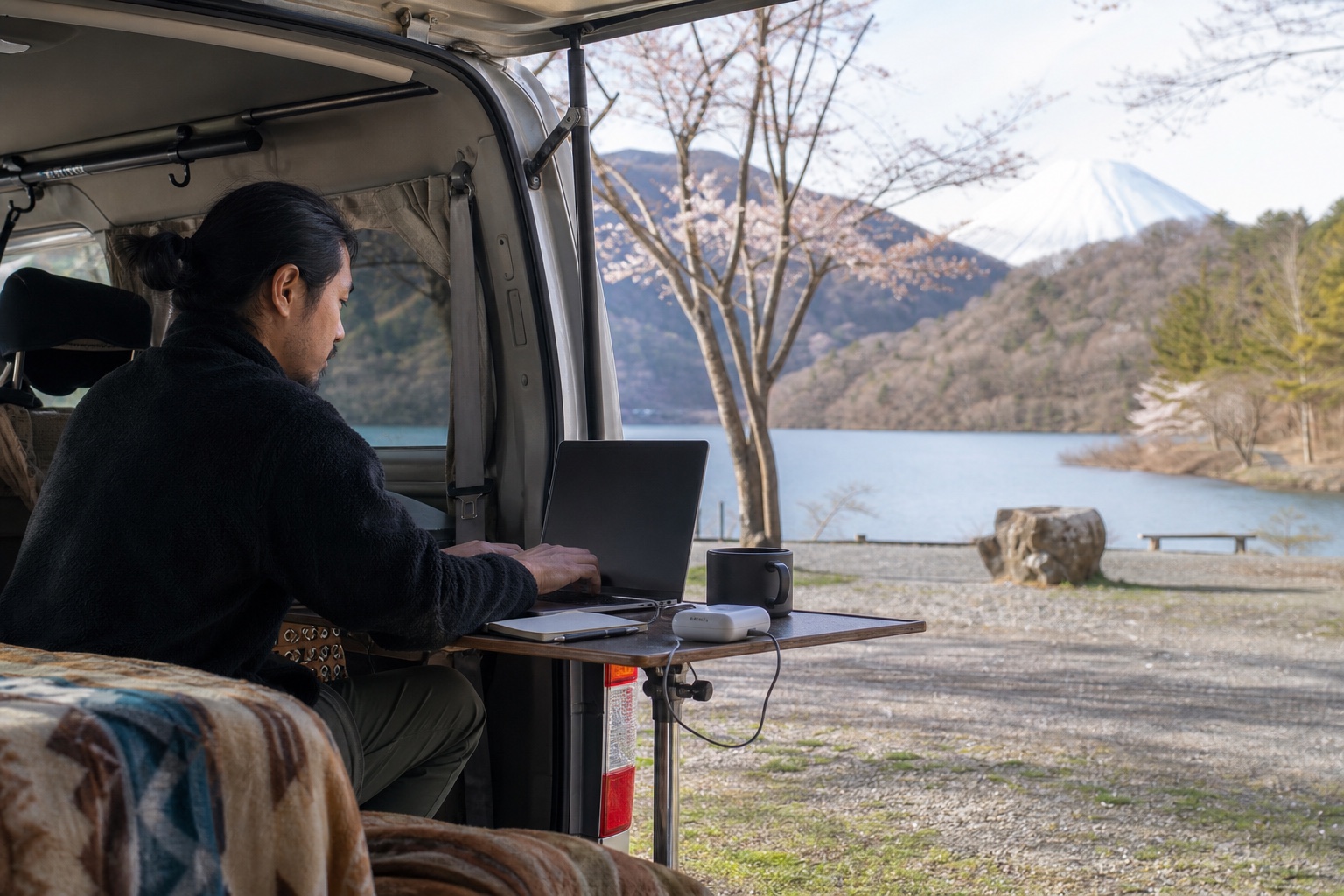
Working remotely from a van in Japan sounds simple: open the laptop, park somewhere beautiful, and answer emails with a mountain or beach outside the window.
Sometimes it really can feel like that.
But most good remote-work van trips are built around less romantic details: mobile signal, battery capacity, bad weather, video calls, parking rules, desk comfort, bathing, laundry, and whether you can find a quiet place when you actually need to focus.
Japan is a good country for this style of travel because it is safe, clean, connected, and full of convenient services. It is also dense, rule-conscious, and not always designed for people to turn public parking into an office. You will never fear letting your laptop or other devices in the car while you're out.
The trick is to treat the van as your base, not your only workplace.
Start with the right kind of trip
Remote work changes the shape of a van trip.
If you are on vacation, a long driving day can be part of the adventure. If you are working, it can ruin the whole week. You arrive late, the van is messy, the battery is low, and the next morning begins with calls instead of coffee.
For remote work, slower is better.
Instead of changing regions every day, plan clusters:
- two or three nights near the same town
- one work-heavy day with very little driving
- one flexible day for sightseeing or moving
- one backup location in case the first spot has poor signal
This rhythm makes the trip feel less rushed and gives you more control over work days.
Internet: do not rely on one connection
Mobile internet in Japan is generally good, but rural valleys, mountain roads, remote coastlines, tunnels, and some campsites can still have weak signal.
For remote work, one connection is not enough if your job depends on calls or deadlines.
A stronger setup is:
- a phone plan or eSIM with enough data
- a pocket Wi-Fi or second carrier as backup
- offline maps downloaded before leaving cities
- important files synced before remote driving days
- a list of cafes, coworking spaces, libraries, or hotel lobbies near your route
If you only need messages and light browsing, a simple phone connection may be fine. If you need video calls, uploads, or screen sharing, plan more carefully.
For more detail, read our internet on the road in Japan guide.
Power: your laptop is the real test
Phones are easy to charge in a van. Laptops are the harder part.
Before the trip, check three things:
- how many watts your laptop charger needs
- whether the van has a house battery or only a starter battery
- whether the rental company allows you to use an inverter
Do not drain the starter battery to work. If the vehicle does not have a separate leisure battery, be conservative and use cafes or coworking spaces for longer sessions.
A practical remote-work kit includes:
- USB-C car charger for smaller devices
- laptop power bank if your computer supports USB-C charging
- extension cable
- compact power strip
- headphones with a microphone
- small desk light or headlamp
- backup battery for your phone
If you are buying or renting a larger camper, ask about solar, battery capacity, inverter rating, and charging while driving. Those details matter more than nice photos of the interior.
The van is not always the best office
Some days, working inside the van is perfect. Rain outside, coffee inside, quiet parking, good signal, no calls.
Other days, it is uncomfortable.
Summer heat can make the van unusable during the afternoon. Winter can be cold if the vehicle has no proper heater. Rain makes it harder to ventilate. Wind can shake the van during calls. A beautiful beach parking lot may be too bright to see your screen.
Use the van when it makes sense, but build a network of backup workspaces:
- cafes with power outlets (Komeda coffee is a good chain with power plugs and wifi)
- coworking spaces in regional cities
- public libraries
- highway service areas
- shopping malls
- campgrounds with common rooms
Japan has many clean, quiet indoor spaces. Remote work gets easier when you stop forcing every work session to happen inside the vehicle.
Where to park during work hours
There is a difference between stopping to rest and turning a parking space into an all-day office.
For short sessions, service areas, rest areas, and some large public parking lots can be practical. For longer sessions, use places where staying for hours is normal or clearly paid for:
- campgrounds
- RV parks
- coin parking
- coworking spaces with parking nearby
- day-use facilities
- large roadside stations where long rest stops are accepted and no prohibition is posted
Be discreet. Do not open a full outdoor office in a busy parking lot, block spaces, leave chairs out where it is not appropriate, or cook beside a place that is meant for short stops.
The more urban or residential the area, the more careful you should be.
Choose regions that support work
The best remote-work van regions are not always the wildest ones.
For a working trip, look for areas with:
- medium-size towns every few days
- good mobile coverage
- cafes and coworking spaces
- onsen or sento nearby
- coin laundry
- supermarkets
- manageable driving distances
- backup indoor activities for bad weather
Good first choices include:
- Izu and the Fuji area
- Nagano and Yamanashi
- Chiba and the Boso Peninsula
- Kansai plus Lake Biwa
- northern Kyushu
- Sapporo, Furano, Biei, and central Hokkaido in summer
Very remote areas can be amazing on days off, but they are riskier if you have fixed calls.
Plan your work week around movement
Remote work from a van works best when driving and work do not compete.
A useful pattern is:
Morning: focused work while the van is still cool and quiet
Lunch: move, shop, bathe, or do laundry
Afternoon: calls or lighter tasks from a stable location
Evening: short drive to the sleep spot, dinner, next-day prep
This avoids arriving at a sleep spot too late and keeps your most important work out of the messiest part of the day.
If you need deep focus, do not schedule a scenic mountain road on the same day. If you need to move regions, protect the next morning by arriving early enough to reset.
Summer and winter change everything
Summer is the hardest season for working inside a van in much of Japan.
Heat builds quickly when the vehicle is parked. Even if sleeping is possible at night, laptop work during the afternoon can be miserable. In summer, choose higher elevations, Hokkaido, Tohoku, or indoor workspaces during the hottest part of the day.
Winter has the opposite problem. Short days, cold mornings, condensation, snow tires, icy roads, and heater safety all matter. If the van has no proper heating setup, long laptop sessions inside can become uncomfortable fast.
Spring and autumn are the easiest seasons for remote work. The van stays more comfortable, travel demand is lower outside major holidays, and you can spend more time working with doors or windows open.
Calls need their own plan
Video calls are the part of remote work that most often conflicts with vanlife.
Before an important call, check:
- signal strength
- noise
- lighting
- battery
- parking rules
- restroom access
- whether you can stay in that spot for the whole call
Do not plan important calls from a location you have never tested. If the call matters, use a coworking space, a quiet cafe, a hotel lobby, or a parked van in a known area with strong signal.
Also think about time zones. If your team is overseas, late-night or early-morning calls may affect where you can park without disturbing anyone.
Keep the van livable
Work gear makes a small van cluttered quickly.
A simple daily reset helps:
- laptop and cables packed in one bag
- wet towels and laundry separated from work gear
- trash removed whenever possible
- bedding folded before starting work
- next-day clothes ready before night
- water refilled before a work-heavy day
The goal is to avoid starting the morning by reorganizing the entire vehicle before opening the laptop.
A realistic first remote-work route
For a first attempt, choose an easy loop instead of a huge cross-country trip.
Example:
Tokyo pickup -> Chiba coast -> Izu Peninsula -> Fuji Five Lakes -> Yamanashi or Nagano -> Tokyo return
This gives you coastal days, mountain days, many backup towns, and enough infrastructure if work gets busy.
For a more relaxed summer option:
Sapporo pickup -> Furano -> Biei -> Daisetsuzan area -> Lake Toya -> Sapporo return
Hokkaido is still not effortless, but the cooler weather and wider roads can make remote work much more pleasant in summer.
Final advice
Remote work from a van in Japan is absolutely possible, but it works best when you plan it as a working road trip, not as a normal holiday with a laptop added at the end.
Prioritize signal, power, quiet, and slow movement. Use cafes and coworking spaces without guilt. Keep the van clean enough that it can become an office quickly.
When the logistics are under control, the reward is very real: finish work, close the laptop, and already be somewhere worth exploring.